
MSP Operations
It's Friday and Nobody Has Entered Their Time: Why MSP Engineers Skip Time Entries, and the Fix That Lasts
At my former MSP, 20 to 40% of time entries never made it into the PSA, until we implemented these fixes. What that costs on T&M projects and fixed-fee renewals, why dashboards and bonuses only worked for a quarter, and the five-minute close-out rule that actually stuck.
Matt Ruck · November 23, 2026 · 8 min read
It's Friday afternoon, and invoices can't go out because half the week's time isn't in the PSA. A frustrated service desk manager sends the third Teams message of the day, and the team leads start writing sarcastic emails that get more threatening each time. If your engineers are not entering their time, you know this scene well. Every MSP I know goes through the same routine.
I ran a large MSP with more than 100 engineers, and we were no exception to the late-Friday timekeeping grind. This post covers what the grind actually costs, the policies I put in place that either didn't last or didn't work, and the one policy change I'd recommend making on Monday morning whether or not you ever buy anything from us.
Both sides have a point
Most advice on this topic starts by blaming the engineers. That's a mistake, because their perspective often isn't wrong. They work hard on difficult technical problems, the queue doesn't stop, and to them time entry is clerical work that comes after the real job. They fixed the problem. Why does it matter how long it took?
Management is right too. Invoicing, time card close-out, utilization reports, CBRs and QBRs all run on that data, the data that comes with resolving the ticket. Without it you can't run the business. So resentment flows both ways: engineers feel management doesn't appreciate the work they do, and management feels engineers don't care about the bigger picture of how the company gets paid.
There's a bigger reason to fix it, too. If you can't get basic time entries and accurate ticket notes, you will never build the foundation for the quality work you actually want from engineers. What's in those ticket notes feeds better documentation in IT Glue or Hudu, sharper written procedures, and up-to-date resolution steps for the next engineer.
What missing time entries actually cost an MSP
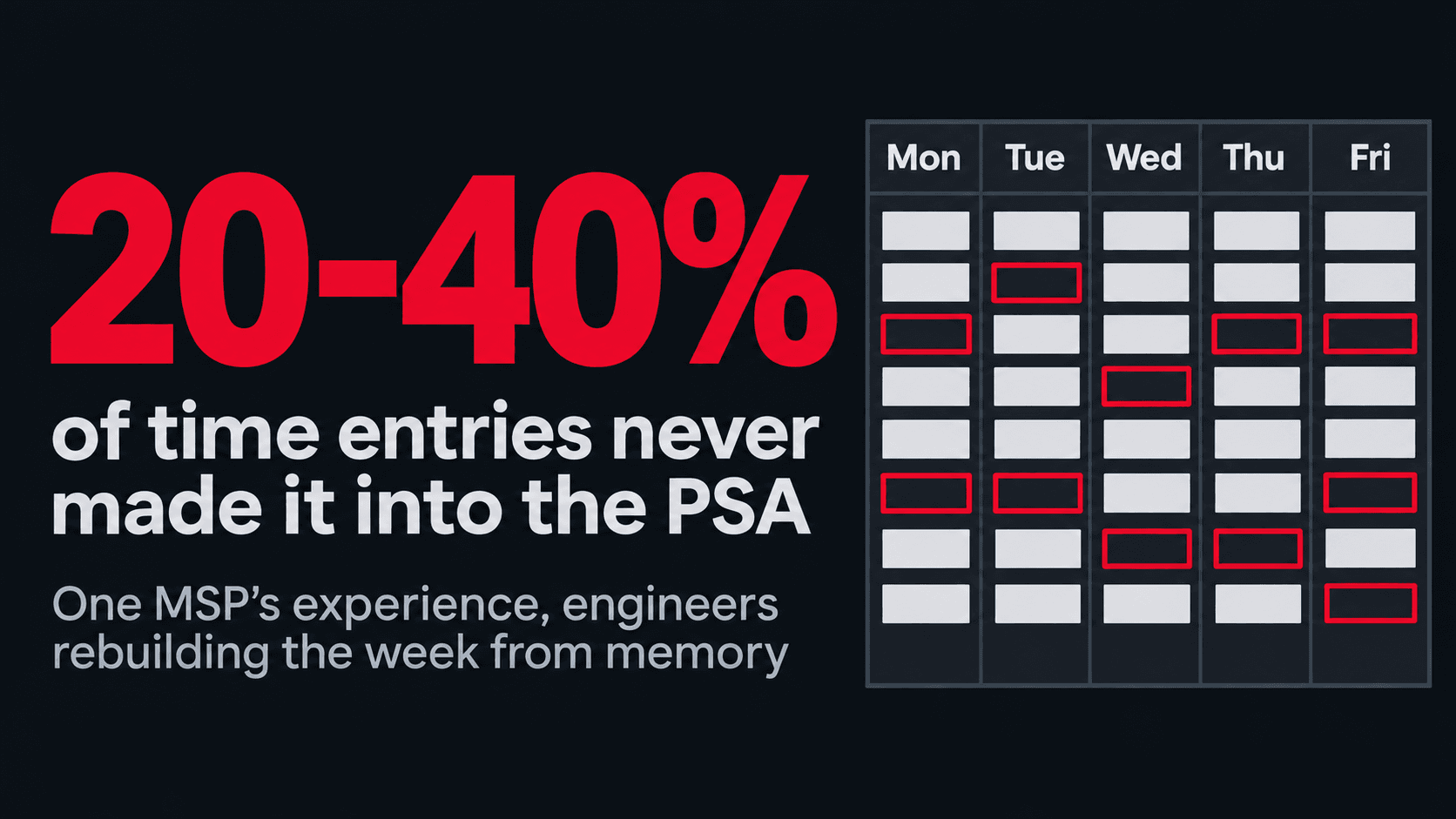
When I measured it at my MSP, between 20 and 40% of time entries were missed entirely. The cause was always the same. After prompting from their managers, engineers tried to rebuild the week from memory on Friday, and nobody could accurately remember what they did on a given day for a given ticket. What they didn't see was how valuable that time was, and that it could never be recovered.
On time-and-materials work, it bleeds out of your margin
A billable project should earn 50 to 55% gross margin. Capture 60% of the time and the labor is still fully paid, so the missing 40% comes straight out of profit. A project that should earn 50 to 55% gross margin, with 40% of its time missing, keeps about a quarter of its profit. Miss half the time and you did the project for free.
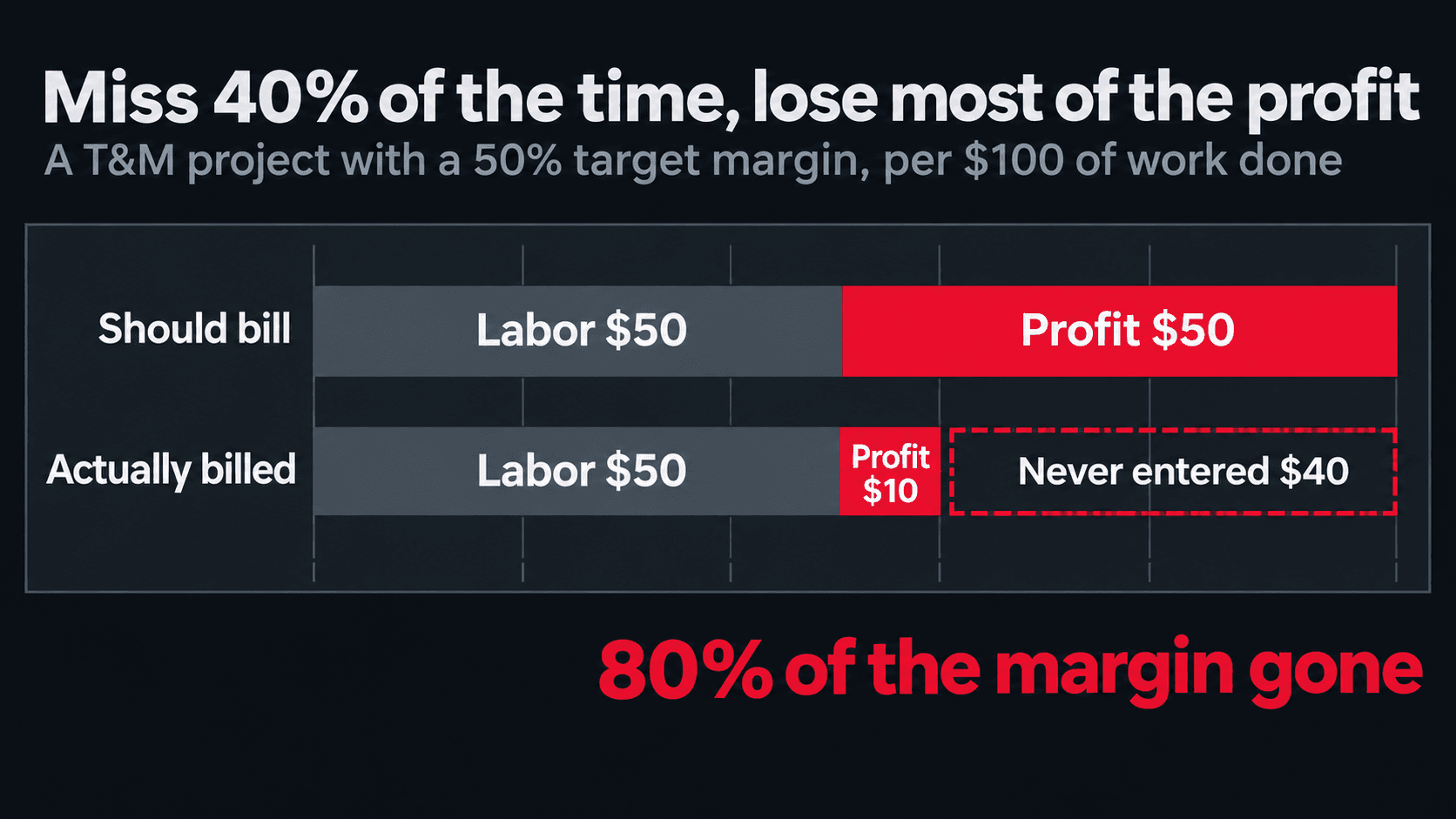
What capturing 60% of the time does to a project's margin
| Target margin | Labor cost per $100 of work | Billed at 60% captured | Profit left | Share of margin lost |
|---|---|---|---|---|
| 50% | $50 | $60 | $10 | 80% |
| 55% | $45 | $60 | $15 | 73% |
I spent a long time asking why our projects team was underperforming. It wasn't the technical work, and it wasn't the account managers' ability to sell projects. It was our inability to capture the data.
And on projects you get one shot. You've been sending the client progress updates all along, so adding hours after the fact looks like padding the bill. If the time isn't entered when the work is done, it's gone.
On fixed-fee work, lost income shows up at renewal
Fixed-fee MSPs often assume that income lost to inaccurate timekeeping doesn't apply to them. It does. Your QBR and CBR reports use that time data to show the client what they get for their fee. With a third of the work missing, the report undercounts it, and at renewal the increase you're asking for looks unjustified. Either way, missing time costs you revenue.
The next engineer pays for it too
When time is rebuilt on Friday, the notes are often rebuilt from memory too, and what survives is a short summary. "Exchange fixed." The steps taken and the vendors involved are gone, and that detail is exactly what the next engineer needs, especially on complex issues.
I saw it most often at handoffs. An engineer would work a long, complicated ticket through Thursday, then go on vacation or get pulled onto something else. The engineer who picked it up had no history to work with and had to rebuild last week's work before making any progress. As a result, I paid for that labor twice.
What I tried that didn't last
I tried everything I've seen other MSPs try:
- Live dashboards that showed who was behind, in the hope that the visibility would motivate people to catch up.
- Grading teams against each other. We ran engineers in pods and made it a game: pods earned points for good ticket notes and time entries, and the pod with the most points won.
- Quarterly bonuses: money for the most compliant pods.
Each one worked for a while. Compliance went up, teams relaxed, and a month or two later it had slipped right back. Looking back, I can see why. All of them were just nagging with better tools. They kept pushing engineers to do the admin work, and none of them made the work any smaller or put it where the engineer already was.
The fix: close the ticket before taking the next one
This is the change I'd make first, with or without new software:
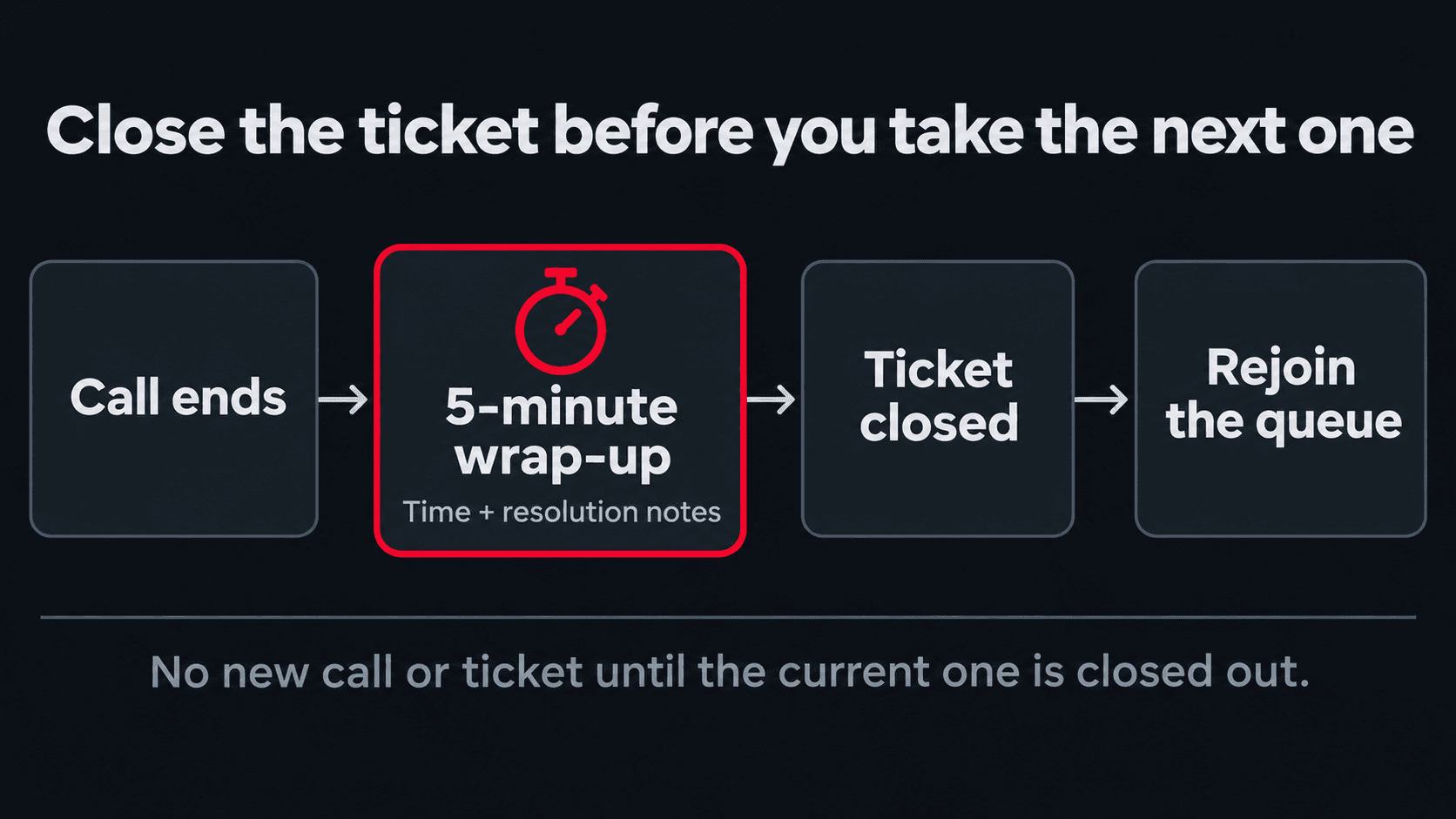
The second half is what makes it last. The dashboards and bonuses depended on engineers remembering to do the right thing. Keeping engineers out of the queue until the ticket is closed puts the rule into how work gets routed, so nobody has to remember it.
Two important things to keep in mind:
- New hires adapt to new policies easily; veterans are hard. Teaching this on day one is far easier than changing an existing technician's habits. Start every new engineer on it, and expect the existing team to take longer.
- Your most senior engineers will push back hardest. They also work the most complex tickets, where missing notes cost the most. Make the case to them first, and in person.
The close-out rule: how to know it's working
Track two numbers, every week:
- 01
Time entered the same day
The share of time entries logged on the day the work was done, from your PSA's time entry log. This tells you whether the policy is being followed.
- 02
Billable hours per engineer, per week
This tells you whether following it pays. If same-day entry goes up and billable hours go up with it, you're recovering time you were already paying for.
What you'll find: capacity you didn't know you had
Here's what surprised me most. Almost every service manager hears the same thing from the team: we're understaffed, and we don't have enough people for the work. At my former MSP, the engineers never thought we were fully staffed.
Once time was entered as the work happened, we found that wasn't true. The capacity was there. We just couldn't see it, because a third of the day never made it into the system.
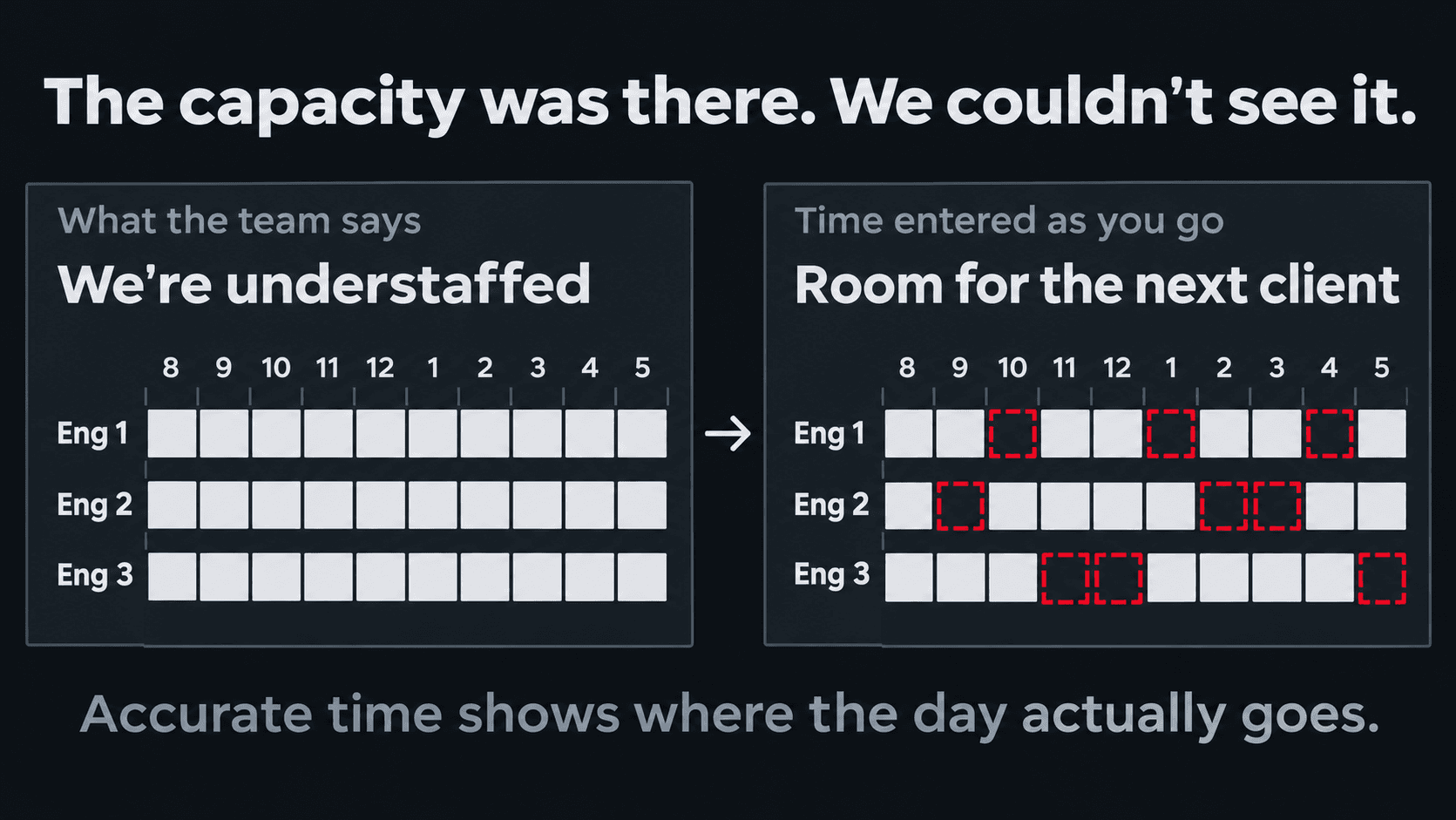
That matters most if you're growing. You can't add clients to a team that's already billing 40 to 45 hours a week, and you can't plan headroom without accurate time. So before you open the next engineering position, get time entry right and look at the numbers again.
Better resolution steps: the payoff that compounds
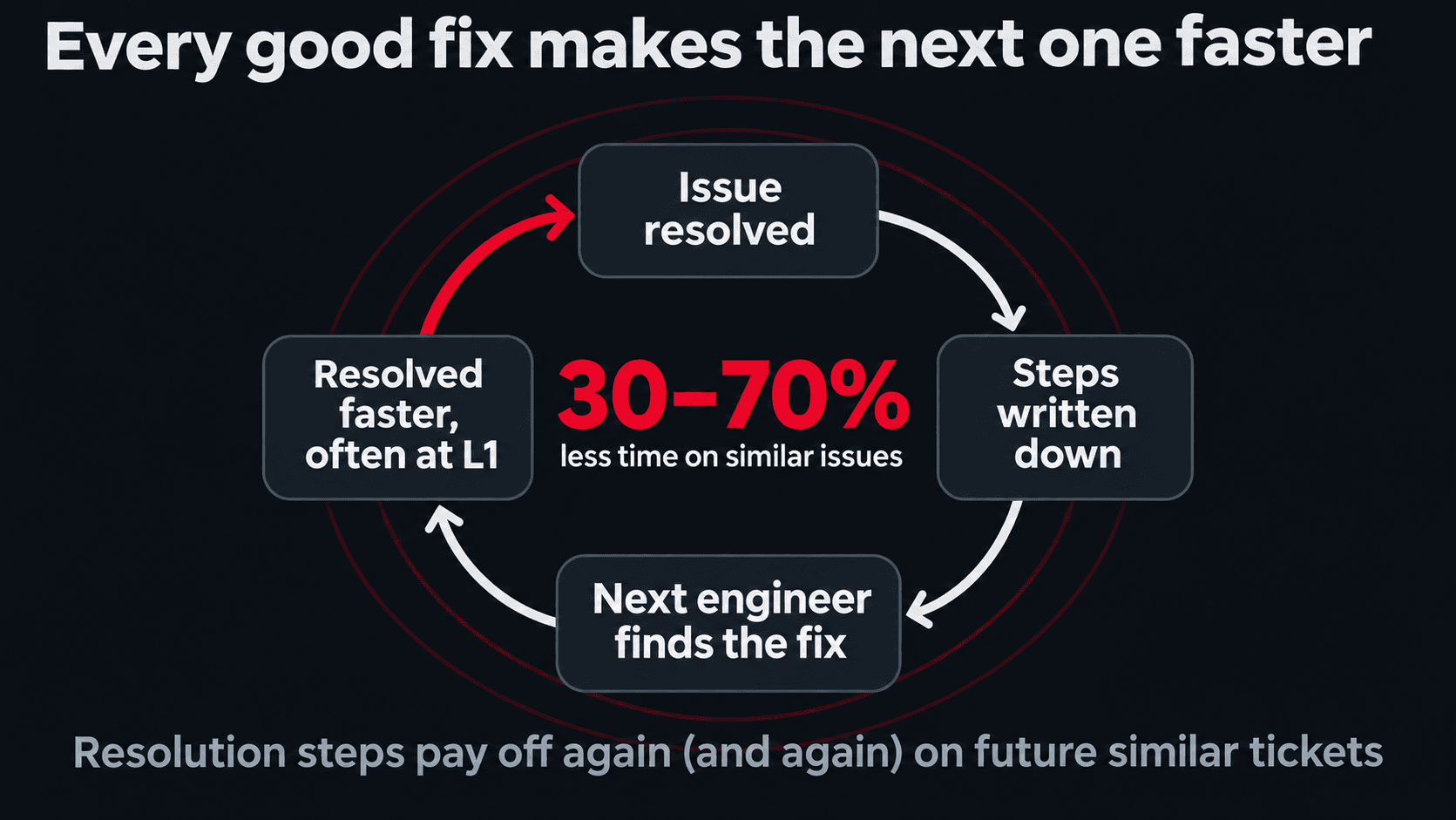
A time entry pays you once, for this ticket. Resolution steps pay you again and again, on every similar ticket after it.
When an engineer writes down what they actually did (the steps taken, the setting changed, the vendor called, what didn't work), the next engineer who hits the same problem doesn't start from zero. They find the earlier ticket and follow it. "Exchange fixed" gives them nothing, so every repeat starts over.
- 30–70%
- less time to resolve similar issues, which is what I've seen at MSPs with strong historical resolution data
It also lets junior engineers take on harder tickets and grow their skills. When the senior engineer's fix is written down, L1 and L2 engineers can resolve issues that used to need escalating, and they can work on their own instead of waiting for help. That means fewer escalations, less load on your most expensive people, and newer engineers who learn faster.
And it builds on itself. Every well-documented fix makes the next similar ticket faster. Faster tickets free up time to document properly, which makes the one after that faster still. Poor notes run the same cycle backwards: every repeat issue costs full price.
This is also the best argument for your senior engineers, the ones who resist the close-out rule hardest. Their notes are the most valuable to your teams. Every fix they document well is one they won't be called in to solve again.
Optimizing the rule: turning five minutes into close to zero
The policy works, but it still asks engineers to type up what they just did. The better answer is to capture the work while it happens, so there's nothing left to rebuild. Here's how our customers do that with Assist-X, in ConnectWise Manage and Autotask:
- On a phone call, the Assist-X transcription agent rides along and writes the ticket notes, the time entry and the resolution steps from the conversation. The engineer reviews them and closes the ticket, with nothing to type.
- Onsite, on the road, or a quick fix from home, Assist-X Mobile on iOS and Android does what the desktop does, transcription included. The engineer doesn't have to open the PSA, find the ticket and enter the time.
- On project work with no client on the line, engineers dictate their notes as they go instead of typing them up later.
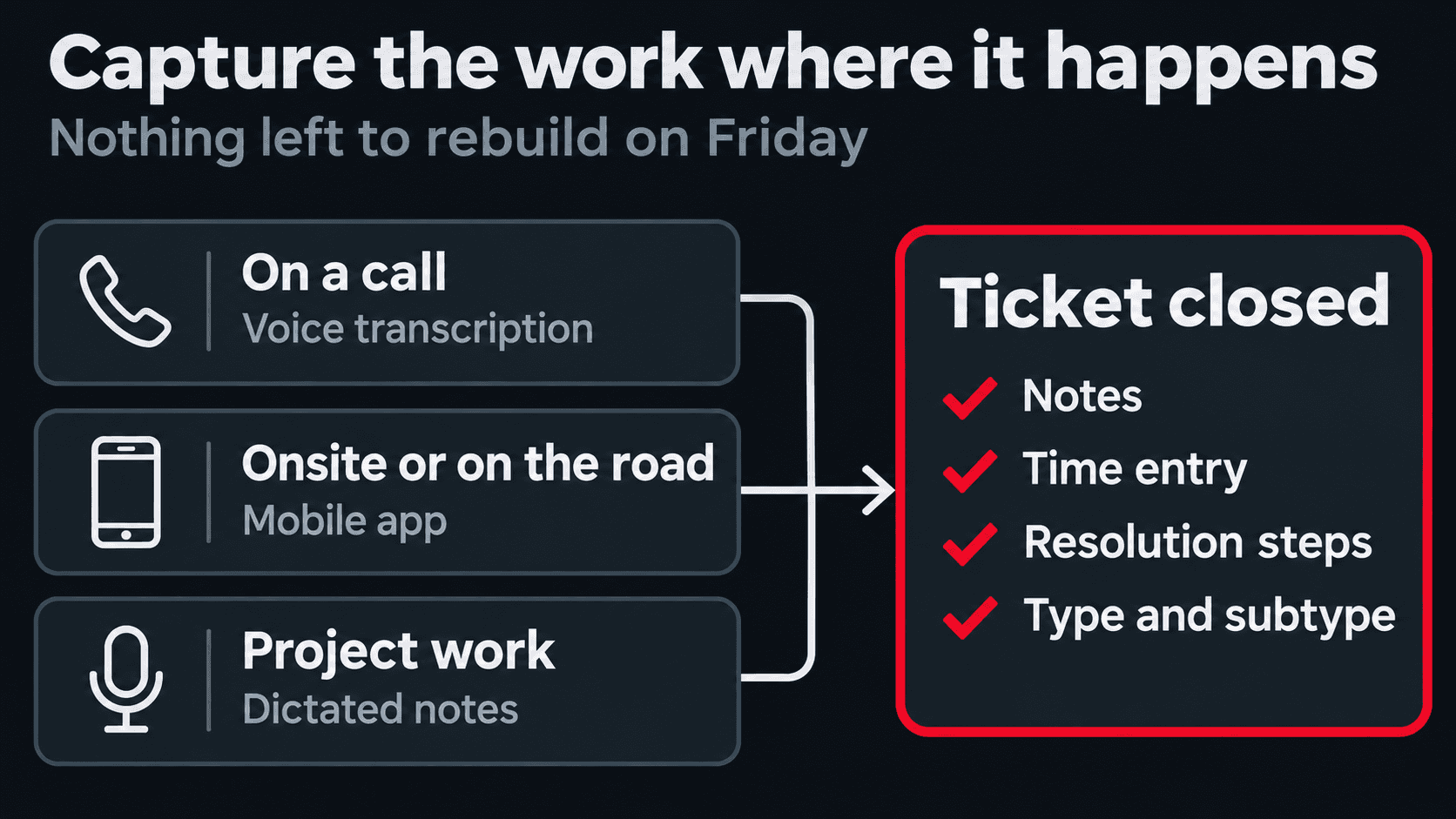
Managers also get the hygiene they've been chasing: tickets closed properly, with the right type and subtype, accurate time, and resolution steps detailed enough that the next engineer can use them.
Those resolution steps feed your documentation, so your MSP gets better with every ticket it resolves. When the next engineer hits a similar problem, Assist-X's Ask AI searches every past resolution and the client's documentation and brings the earlier fix to them. That's where the time saved on similar issues comes from.
We're often asked the following
Why do engineers not enter their time?
Mostly because they see it as clerical work that's separate from fixing the problem, and the queue never stops long enough to do it. So it gets pushed to the end of the day or the end of the week, and by then it can't be remembered accurately.
How much revenue do missing time entries cost an MSP?
At my former MSP, 20 to 40% of time entries were missed when engineers rebuilt their week from memory. On a T&M project with a 50 to 55% target margin, missing 40% of the time removes about three-quarters of the profit. Your numbers will differ, so compare billed hours to scheduled hours for one month and see.
Does this matter if all our clients are on fixed-fee agreements?
Yes. Fixed-fee renewals are justified with the work shown in QBRs and CBRs. If a third of the work never reaches the PSA, the report undercounts what you delivered, and your renewal increase looks unjustified.
Should time entry compliance be tied to bonuses?
We tried it. It helped for a quarter and then wore off, the same as dashboards and team rankings. A close-out rule built into the queue lasted longer than any incentive we tried.
How do better ticket notes reduce time to resolution?
When resolution steps are written down, the next engineer with a similar problem can find and follow the earlier fix instead of working it out again. MSPs with strong historical resolution data see 30 to 70% less time to resolve similar issues, in my experience, and their L1 and L2 engineers escalate less.
What should we measure?
Two numbers: the percentage of time entered the same day the work was done, and billable hours per engineer per week. The first shows compliance. The second shows the payoff.